
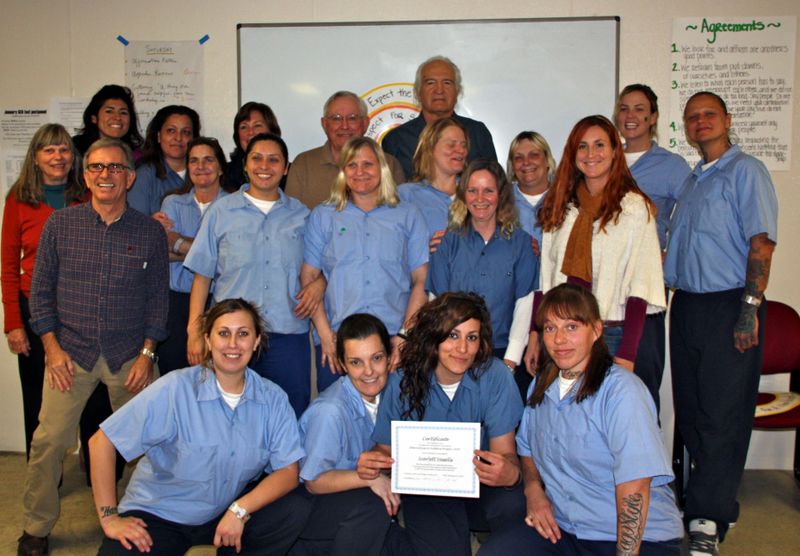
Workshops are the heart of AVP's work, in which participants explore and learn about relationships, communication skills, cooperation, and resolving conflict non-violently through experience. Experiential learning, not teaching, is key to AVP workshops.
To take part in a workshop, please:
- Contact the Local Council nearest to you for more information.
- See the calendar of workshops coming up.
- See the list of prisons in which AVP is working, then contact us, and someone will be in touch with you as soon as possible to discuss opportunities and the rules and requirements for going into a prison.
- Prior to, or after taking a workshop, please enter your information on our sign-up form so that we can keep a record of your participation and interest in future workshops.
Workshop coordinators may be able to provide accommodation, or recommend reasonable local accommodation for participants who live far away. Community workshops generally request a sliding-scale donation of between $25 - $125 to support AVP's work. However, no one is turned away for lack of funds.
Mini-workshops are also available, ranging between 1-4 hours. Please inquire if you or your organization is interested in a 'sample' of AVP.
Structure:
There are three levels of workshop: Basic, Advanced, and Training for Facilitators (T4F). Each workshop is between 18 and 22 hours, usually taking place over two or three days. All AVP workshops are experiential and fun, as well as transformative.
In addition to prisons, workshops take place in schools, community centers, churches and nonprofit organizations. There are usually between 15 and 20 participants in a workshop.
Basic level workshops focus on:
- Communication
- Affirmation
- Trust
- Building Community
- Creative ways to resolve conflict
Advanced level workshops focus on:
- Underlying causes of conflict such as fear, anger, stereotyping, power and powerlessness
- "Old history" and behavior
- Ways of resolving conflicts, including communication and forgiveness
- Using consensus to make decisions
- A specific theme chosen by the workshop participants
 Who Facilitates Workshops?

People of all ages and backgrounds, inmates and 'outsiders', are AVP facilitators.
Workshops are facilitated by teams of usually between three and six volunteers. Facilitators have different levels of experience, and each team is guided by a team coordinator who focuses on logistics and mentoring and supporting other facilitators' growth.
In prisons, the majority of the facilitation team is usually comprised of inmates who have completed the three workshops. In California, for a workshop inside prison, AVP requires only that one facilitator from the outside be part of the team. Having an 'outsider' as part of the team brings valuable diversity to the workshop. On the other hand, there is more demand for workshops inside prison than there are outside facilitators available to join. That's why we want you to volunteer with us!
AVP facilitators are volunteers. Their expenses for travel and lodging may be reimbursed.
Become a Facilitator
- Take the three workshops - Basic, Advanced, Training for Facilitators (T4F).
- T4F workshops focus on: group processes, working as a cooperative team, hands-on experience
- AVP methods: Agenda Building, Exercises, Transforming Power, Light and Livelies, Role Plays, etc.
- Facilitate three workshops as an apprentice in order to develop your skills and confidence, then become a Certified Facilitator.
- After facilitating five workshops as a Certified Facilitator, you can be mentored in at least three more workshops to become a Team Coordinator.
We look forward to hearing from you!